

The competitor who won that last project didn’t have a better product.
They had a different conversation. Four months earlier. With a different person.
Last week I wrote about something that’s been on my mind for a while. The fact that a significant share of motors still run direct-on-line, not because drives are expensive, not because customers don’t care about energy costs, but because nobody showed up before the decision was made.
That post struck a nerve.
What I didn’t get into, and what I think matters more, is what showing up early actually looks like. Not in theory. In practice. In a real industrial site, with a real maintenance manager, six months before any budget conversation starts.
Because “be more proactive” is not advice. It’s a direction without a map.
The Window Nobody Talks About
Every significant capital decision in a manufacturing or industrial environment has a window.
It opens somewhere between 6 and 18 months before the formal procurement process begins. During that window, the real commercial work happens. Costs are made visible. Problems get given names. The business case gets constructed or it doesn’t.
When the RFQ lands in your inbox, that window is already closed.
The specification has been written. The technical requirements were shaped by the partner who walked the floor earlier. The internal stakeholders have already formed a view. The budget line exists because someone already justified it.
Your response to the RFQ is technically a competitive process. Commercially, it’s often a confirmation exercise.
Most automation partners spend almost all of their sales energy inside a closed window.
Who You Actually Need to Talk To
Here’s where most proactive outreach fails, even when partners do attempt it.
They go back to the engineer.
The engineer is comfortable. You speak the same language. The conversation is easy. You talk specifications, cable sizing, harmonic distortion, protection class. It’s productive. It feels like progress.
It isn’t. Not commercially.
The engineer evaluates. They do not decide. And in most cases, they are not the person who feels the financial pain of doing nothing.
The person who feels it is the Operations Director or the Plant Manager.
They are looking at an energy bill they cannot explain. A maintenance log full of motor failures they are told are just “wear and tear.” A process that runs at full load 24 hours a day because nobody has ever questioned whether it needs to.
They are not waiting for a technical proposal. They are waiting for someone to come in and make the invisible cost visible.
That’s the conversation most automation partners never have — because they never get in front of the person who needs to have it.
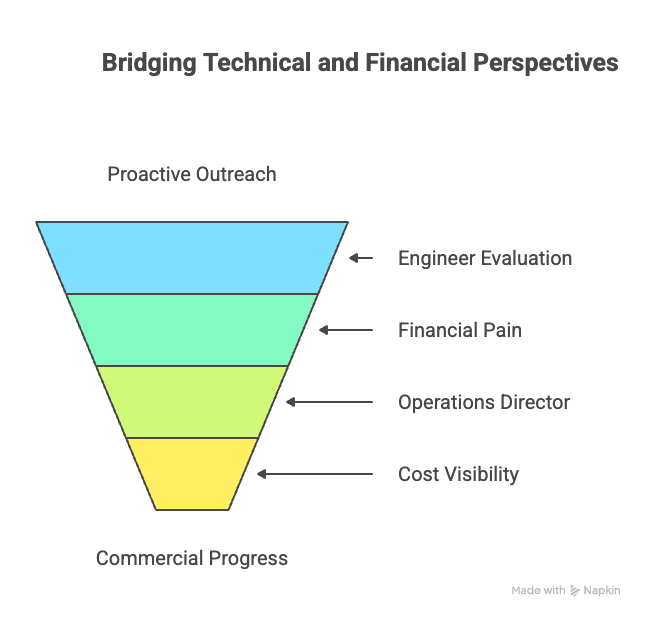
What the Proactive Visit Actually Looks Like
It doesn’t start with a product presentation.
It starts with a question.
“Can we walk the floor together? I’d like to understand what’s running and how it’s being used.”
That’s it. No pitch. No catalogue. A request to observe and understand.
On that walk, you’re not selling. You’re building a picture. Which motors are running fixed speed? What are they driving — fans, pumps, compressors? What does the load profile look like across a shift? Are there processes that vary in demand but run at constant speed anyway?
You’re looking for applications where variable speed control would reduce energy consumption. The cubic law — the relationship between speed reduction and power consumption — does the rest.
But here’s what changes when you’re in the room with the Operations Director instead of the engineer:
You’re not explaining the physics. You’re translating it into money.
Not “reducing speed by 20% reduces power consumption by approximately 49%.”
But: “That motor is running at full load around the clock. Based on what I’m seeing, there’s a reasonable case that you’re spending significantly more than you need to. Can I run the numbers on this specific application before we go further?”
One sentence. Grounded in observation. No jargon. No specification sheet.
That’s what opens the real conversation.
The Numbers That Move the Decision
The cubic law is a powerful tool.
But only when it’s applied to a real application, with real operating conditions, in front of a person who controls the budget.
When I show someone that a 90 kW motor running fixed-speed in a variable-demand application can draw closer to 35 kW under real operating conditions, that’s not a theory. It’s a number attached to a motor they can see, a process they own, and an energy bill they’ve been paying.
The question that follows almost always comes from them: “How many motors like this do we have in the plant?”
That question is worth more than any proposal you could have submitted.
Because now the customer is doing the commercial calculation themselves. They’re multiplying. They’re thinking about the full site. They’re building the internal business case and you’re the one standing next to them when they do it.
That’s not selling. That’s creating the conditions in which the customer sells to themselves.
Why Most Partners Can’t Do This Yet
The honest reason is not laziness or lack of ambition.
It’s structure.
Most automation partner businesses run on a rhythm that doesn’t have room for this kind of visit. The week fills up with quoting, delivery, technical support, customer issues. Proactive outreach gets pushed to “when things slow down” and things rarely slow down.
The team capable of having these conversations, the people who understand both the technical application and the commercial conversation, are already fully deployed on reactive work.
And the sales process, where it exists, is built around responding. Not creating.
This is the real constraint. Not skill. Not knowledge. Structure.
The partners who have solved this have done one thing differently: they have separated proactive commercial activity from reactive delivery. They protect time, on the calendar, every week, for visits that have no quote attached to them yet. They track target accounts, not just active opportunities. They define who they want to be talking to six months from now and they start those conversations today.
It sounds simple. It requires a system.
The Question Worth Sitting With
If you mapped out the conversations your team had last month, every customer visit, every call, every meeting… what percentage of them happened because the customer reached out first?
And of the ones you initiated, how many were in front of an Operations Director or Plant Manager before any budget conversation existed?
Most partners, if they’re honest, find that nearly all of their commercial activity is reactive. Not because that’s the strategy. Because that’s what the structure produces.
The motor isn’t the problem. The motor is just where the cost becomes visible.
The question is: who is walking the floor to find it?
If this resonated, I’d be curious where the constraint sits in your business. Is it the time, the structure, the right people in the room, or something else?
If you’d like to look at one of your own deals, book an Industrial Sales Discovery Call: 30 minutes on Teams, no charge. Bring one recent deal and we’ll explore what shaped the outcome and agree the next step.